
What 100 CQC Inspection Reports Show Good Care Services Do Differently
We read 100 recent CQC inspection reports for care homes and home care agencies. Three in four services were rated Good or Outstanding. What set them apart from the rest was how closely they checked their own work.
By HeroDocs Team
What does a CQC inspection reward? To find out, we read 100 recent CQC inspection reports for adult social care services and recorded what inspectors found. The sample covered 60 care homes, 38 home care agencies and 2 supported living services, picked at random from CQC's own directory, with reports published between April and September 2026.
Most of the news was good. 75 of the 100 services were rated Good or Outstanding. The other 25 were rated Requires improvement or Inadequate, and the two groups differed in ways any manager can act on.
Services in the lower group rarely lacked policies. What they could not show was that staff followed them, that records were kept current, and that managers checked their own work and acted on what they found.
What separated Good services in a CQC inspection
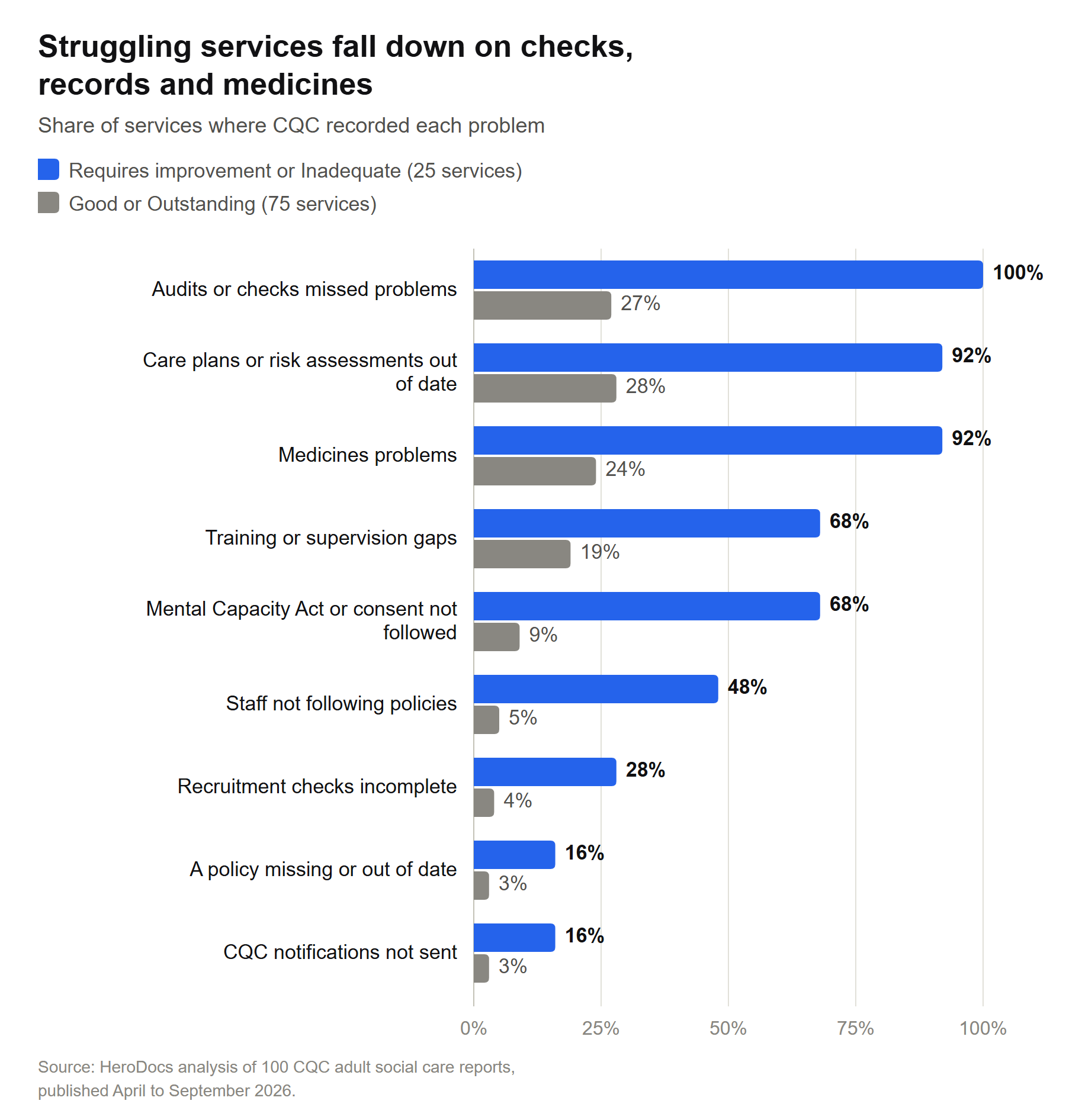
The table counts services where the report recorded a problem at least once.
What inspectors found | Good or Outstanding (75) | Requires improvement or Inadequate (25) |
|---|---|---|
Audits or management checks missed problems | 27% | 100% |
Care plans or risk assessments incomplete or out of date | 28% | 92% |
Medicines management problems | 24% | 92% |
Training, competency or supervision gaps | 19% | 68% |
Mental Capacity Act or consent not followed | 9% | 68% |
Staff not aware of or not following policies | 5% | 48% |
Recruitment checks incomplete | 4% | 28% |
A policy missing, out of date or generic | 3% | 16% |
CQC notifications not sent or late | 3% | 16% |
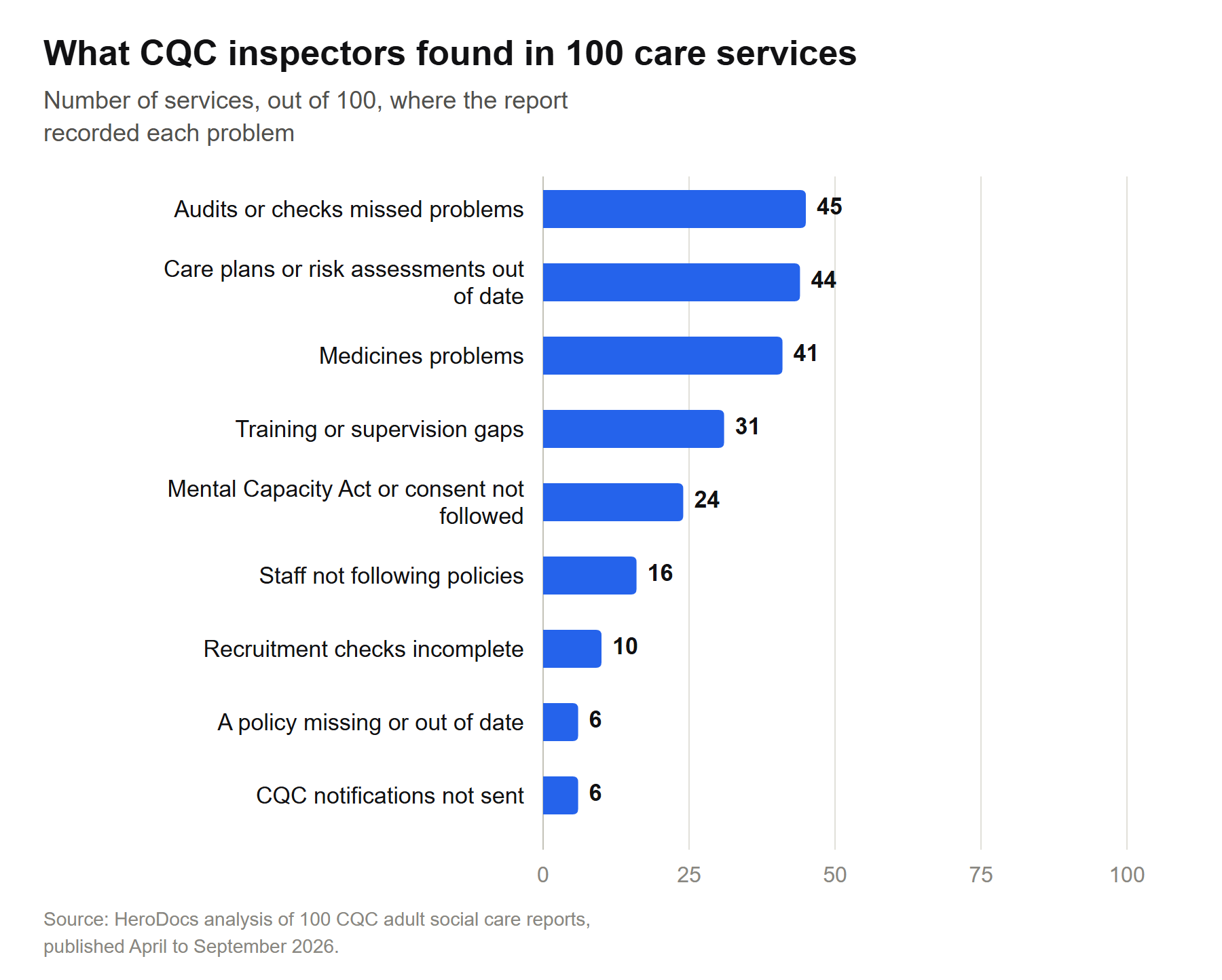
All 25 lower-rated services had weaknesses in their audits or management oversight. Missing or out-of-date policies were rare, at 6 services in the whole sample. Far more, 16 services, had staff who did not know or follow the policies already in place.
1. Audits that find things
Audit and oversight problems were the most common finding of all, in 45 of the 100 reports. Inspectors kept describing the same pattern: audits had been done, but they had not picked up the issues the inspection team found in a day or two.
A tick-box audit asks whether a care plan exists. A useful one asks whether the care plan matches what staff did yesterday. Good services audit by sampling: pull three care plans, read the daily notes beside them, and check the two agree. When an audit finds nothing for months on end, they treat that as a warning sign.
Our care home audit checklist sets out what to cover and how often.
2. Policies staff follow
In the reports, the policy itself was rarely the issue. Inspectors described services with a safeguarding policy that staff had not followed when it mattered, medicines procedures that were not applied on shift, and policies that existed but had not become part of daily practice.
Good services close that gap in three ways:
staff read and sign each policy, and sign again when it changes
supervision includes a short question about a current policy, such as what to do with an unexplained bruise
managers watch practice and compare it with the written procedure
The signature matters because it is the first thing an inspector can check. In HeroDocs you can send a policy for sign-off and track who has signed, so you can see the gaps before an inspector does.
3. Records that move when people change
Care plans or risk assessments were incomplete or out of date in 44 of the 100 reports, and in 23 of the 25 lower-rated services. Timing caused many of them. A person's needs changed after a fall, a hospital stay or a new medicine, and the plan stayed the same.
Good services tie reviews to events as well as dates. Any incident, admission or medication change triggers a care plan check within days, whatever the review calendar says.
4. Medicines: the protocol and the record
Medicines problems appeared in 41 reports. The reports pointed to missing or unclear "as required" (PRN) protocols, gaps on medicine administration records, and staff giving medicines without a recent competency check.
Three plain habits cover most of it: a PRN protocol for each as-required medicine, a weekly sample of MAR charts, and competency checks that are dated and repeated.
5. Training that is current and checked
Training, competency or supervision gaps showed up in 31 reports. Inspectors noted out-of-date courses on training matrices and supervisions that had slipped. Good services track expiry dates and arrange refreshers before they lapse, and they book supervision as a fixed appointment that the rota has to work around.
6. Mental capacity and consent
Problems with the Mental Capacity Act, consent or DoLS appeared in 24 reports, mostly in care homes. Typical gaps were restrictions such as bed rails or CCTV in use without a capacity assessment and best interests decision on file. Good services list restrictions on their own, then check that each one has its paperwork.
7. Notifications with an owner
Missed or late CQC notifications appeared in 6 reports, four of them in lower-rated services. Inspectors found incidents that met the threshold for a statutory notification, but no notification had reached CQC. Good services name one person who owns notifications and a deputy, and check the incident log against sent notifications once a month.
Our full list of CQC statutory notifications explains what needs reporting, and our guide to the CQC notification of death covers the hardest one.
How we did this
The 100 services were picked at random from CQC's public directory, and each had a report published between April and September 2026. A script flagged sentences that pointed to a possible problem. An AI review confirmed which were real and sorted them into nine topics, and we checked a sample by hand.
Treat the figures as minimums, because an unusually worded finding can slip through. The lower-rated group is only 25 services, so read its percentages as a guide. We have not named any service, and CQC publishes its reports under the Open Government Licence.
Last checked: 6 October 2026.
Sources
CQC, Using CQC data, including the directory of registered services
CQC, Notifications
The National Archives, Open Government Licence